


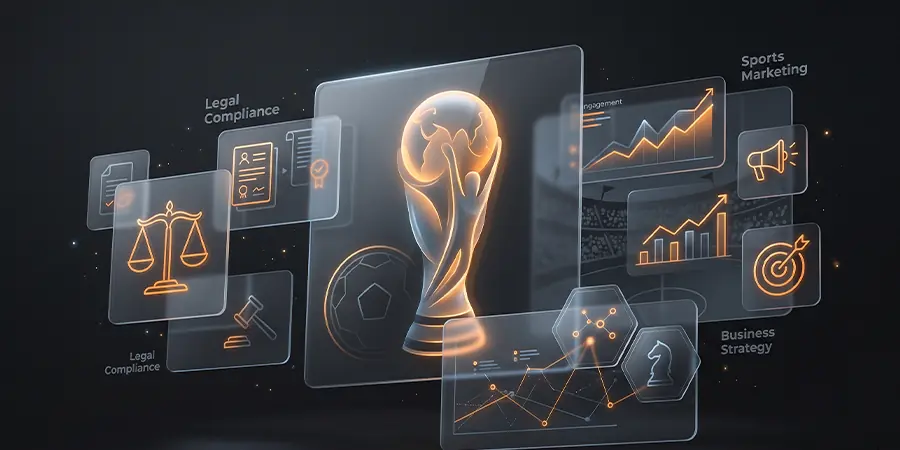
Major sports organizations are always a massive marketing opportunity for brands. The 2026 FIFA World Cup is ahead of us, and many businesses are already planning to broadcast matches in their branches, design tournament-specific packaging, or create “World Cup” themed loyalty programs.
However, when these campaigns, excitedly prepared by marketing teams, do not pass through a legal filter, they can expose businesses to very serious sanctions such as copyright infringement, unfair competition, and trademark violations. So, how should the legal compliance of commercial activities be ensured in this process? In this study, we aim to provide guidance to draw the boundaries around FIFA’s strict rules and Turkish law.
FIFA’s Intellectual Property Axis
FIFA has globally registered almost every detail regarding the World Cup and protects these rights extremely aggressively. FIFA’s red lines, constantly scanning digital platforms, social media, and trademark registries, are very clear. Some of the registered assets that only official sponsors can use for commercial purposes are:
- Official Emblem, Slogan, Mascot, and Trophy Image
- Specially designed “FWC 26” typeface
- Critical Word Marks: “FIFA World Cup 26”, “FIFA World Cup”, “World Cup 26”, “World Cup”, “FIFA”, “Copa Mundial”, “Coupe du Monde”, “Mundial”
FIFA even detected and stopped a local business from selling products bearing the phrase “World Cup 2010” during the 2010 World Cup.
The Trademark Infringement Trap According to the Industrial Property Code (IPC)
Thanks to international agreements to which Turkey is a party, FIFA’s registrations are under full protection in our country as well. Article 7/2 of the Industrial Property Code (IPC) No. 6769 prohibits the use of registered signs without the permission of the trademark owner.
Especially clause (c) is a major risk for brands. “FIFA World Cup” holds the status of a globally well-known trademark. Regardless of your business’s sector, attempting to gain an unfair advantage from the tournament’s reputation by using the phrase “World Cup” in your campaigns will directly be considered trademark infringement.
The Fine Line in Social Media and Score Prediction Setups
Social media contests and loyalty games in mobile apps, which are the heart of marketing activations, are among the areas FIFA pays the most attention to.
FIFA rules are very clear: If you are not an official sponsor, you cannot organize any campaign, contest, game, or raffle that will create an unauthorized commercial association between the tournament and your brand.
How to Stay Safe? If you are going to hold a score prediction contest on your mobile app or social media; you absolutely must not use phrases such as “FIFA, World Cup, World Cup 2026” and images belonging to the tournament in the name, text, or visuals of the campaign.
Structuring your campaign entirely on neutral, generic concepts such as “Football Feast”, “Prediction of Critical Matches”, or “Great Football Excitement” will protect you from both getting on FIFA’s radar and possible lawsuits.
While catching the wind of the 2026 World Cup, focusing on generic and creative marketing strategies that do not violate FIFA’s intellectual property rights is the only way to protect your brand’s reputation and its coffers.
Evaluation Within the Scope of Betting Legislation
Today, many brands organize various gamification setups through their mobile applications to increase user engagement and create customer loyalty. At the forefront of these setups are score prediction contests for sports competitions.
These campaigns, which sound extremely innocent and fun, such as “Make 3 correct predictions, win 1 free coffee” or “Guess the derby score, grab the discount”, actually harbor very serious criminal sanction risks under the Law No. 7258 on the Arrangement of Betting and Games of Chance in Football and Other Sports Competitions, in addition to serious intellectual property risks in the background.
The Misconception of “We Don’t Charge an Entry Fee, Why Should It Be Considered Betting?”
The most common misconception brands fall into is the thought that the setup will not be considered a bet because no participation fee or money is taken from the consumer. However, things do not work that way in criminal law doctrine and established precedents.
Even if no fee is charged to consumers, offering a predetermined and guaranteed material gain (e.g., free coffee, gift certificate, product) dependent on the condition of predicting the outcome of sports competitions carries the risk of being evaluated as a fixed-odds betting mechanism. According to Law No. 7258, it is not required for the organizing institution or brand to directly gain a financial benefit for the crime of organizing illegal betting to occur.
Severe Criminal Sanctions and the Risk of Closure
If such a setup is evaluated within the scope of illegal betting, the sanctions stipulated by the law are quite severe:
- Imprisonment and Judicial Fine: According to Article 5 of Law No. 7258; those who have such games played or provide a place/opportunity for them to be played are tried with imprisonment from 3 to 5 years and a judicial fine of up to ten thousand days.
- Crime of Encouragement: Those who encourage people to play these games by advertising and other means are punished with imprisonment from 1 to 3 years and a judicial fine of up to three thousand days.
- Workplace Closure and License Cancellation: Workplaces where crimes falling within the scope of the article are committed are sealed and closed for 3 months without warning by the highest local civil authority. In addition, business opening and operating licenses are canceled by the competent administration within 5 business days.
Legally Compliant and Safe Solution: Reward System Based on Participation, Not Prediction
So how can brands preserve the app’s engagement goals while eliminating legal risks? The solution lies in removing the setup from a betting mechanism and transforming it into a completely risk-free loyalty program.
In this context, the correct prediction condition required for winning an award must be eliminated. When the setup is revised as follows, the safest legal harbor is reached:
Safe Model: “Make a score prediction (regardless of the accuracy of the outcome) and log into the app on match day (check-in) = Win 1 Free Coffee”
Why is this model safe?
- Does Not Get Caught in the National Lottery Legislation: Since there is no draw or lottery involved, it is not subject to the rules and permission processes of the National Lottery Administration (MPİ).
- Does Not Get Caught in the Betting Law: Since the winning of the award is tied directly to the user’s in-app action, not to the outcome of the match or success, it does not have the nature of a bet.
In summary; it is of critical importance for brands to pass their gamification dynamics through a legal filter while designing loyalty applications in order to prevent possible losses of reputation and severe criminal sanctions.
Ambush Marketing: Appearing Like a Sponsor Without Paying the Price
During major sports organizations, one of the strategies brands resort to most frequently, but navigate in the most legally dangerous waters, is ambush marketing. In short; it is a brand establishing a commercial connection with events in a way that creates the impression as if it were an official sponsor of the tournament, without paying any license fee.
FIFA and similar giant organizations show zero tolerance to such initiatives to protect the rights of their official sponsors who pay millions of dollars. Moreover, in terms of Turkish law; marketing using the image of a tournament with which you have no official relationship could mean violating not only trademark law but also directly the unfair competition provisions of the Turkish Commercial Code.
Is There No Safe Way to Celebrate the Tournament?
Brands do not need to completely ignore the excitement of the tournament. Even FIFA acknowledges in its guidelines that businesses have legitimate ways to reflect the general football enthusiasm. The golden rule here is: not creating the impression of being a sponsor or licensee associated with FIFA.
Communication Boundaries to Pay Attention To:
- Logos Cannot Come Side by Side: You cannot use any FIFA element or the phrase “World Cup” together with your brand’s logo.
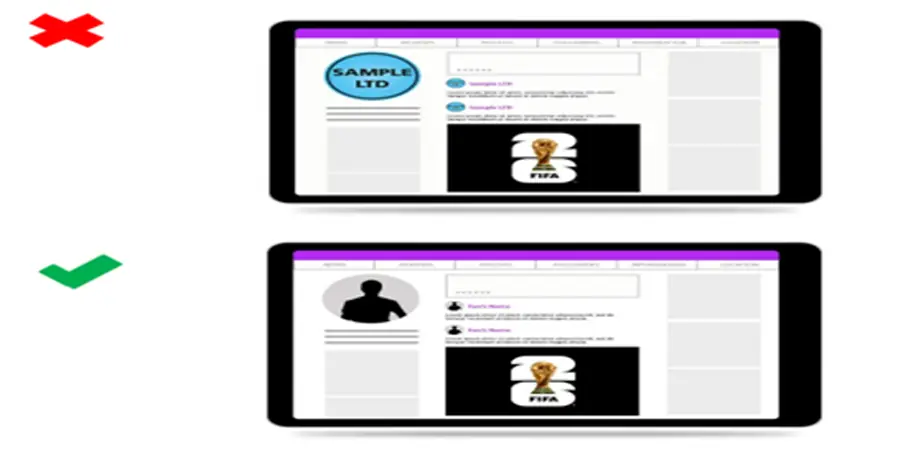
- Individual Use vs. Commercial Use: While a football fan sharing tournament visuals on their own social media does not pose a problem, a commercial business doing so is directly considered commercial unfair use. Posts made from brand accounts must be completely cleared of registered trademarks.
Where Do Boundaries Begin in Product Packaging and Menu Names?
FIFA does not stipulate that businesses that do not use its official IP assets should completely ignore the tournament. Section 5 of the guidelines provides a clear ground on this issue:
“There are legitimate ways to celebrate the Tournament without using FIFA’s intellectual property or creating an unauthorized commercial association with the event. FIFA encourages businesses and the public to use general football or country-related imagery and/or terminology that does not contain any FIFA intellectual property.”
“Activities that create an unfair commercial association are not permitted and such activities are subject to legal sanctions. The unfair commercial association in question occurs when a company creates the impression that it is associated with FIFA or the Tournament, for example, as a sponsor or licensee, by using Official Intellectual Property or by other means.”
Cafes, restaurants, and retail brands must pay attention to these fine lines when designing tournament-specific menus or product packaging (e.g., custom-designed coffee cups):
- Universal Language of Football is Free: You can focus on the universal nature of football instead of “World Cup” in your designs. For example, generic slogans you use on your packaging, like “There is happiness behind every goal,” do not create any trademark infringement as they reflect football terminology.
- Thematic Naming: Names you add to your menu such as “Extra Time Espresso” or “Golden Goal Latte” can be safely used since they are not registered word marks. However, marketing these products under the title “World Cup Menu” directly pulls you into the risk zone.
- Alternative Expressions: Using neutral and original expressions like “Football Festival”, “Big Match Period”, or “Football Season” instead of “World Cup” is the safest way.
Boundaries Regarding the Use of Printed and Digital Media
The FIFA IP Guidelines draw a clear distinction between editorial use and commercial use:
“Official Intellectual Property may not be used in conjunction with or in close proximity to a company logo or commercial attributions such as ‘Presented to you by…’, ‘Presented by…’, or ‘Supported by…’.”
The point to be particularly noted in terms of this provision is the following: The use of any FIFA IP element or the phrase “World Cup” together with its own logo in posters or digital materials may pose a similar risk of commercial association, even in the absence of the expressions listed above.
(Below are visuals regarding appropriate and inappropriate examples)
Social Media Usage
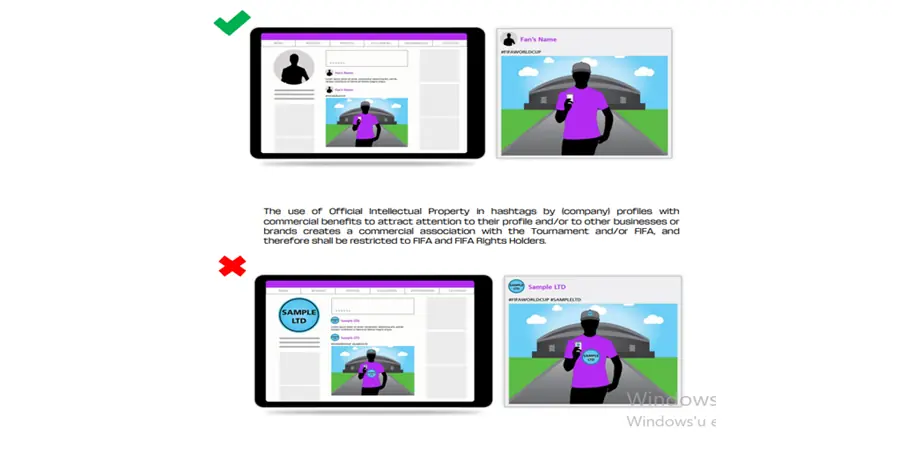
“The use of Official Intellectual Property by fans for non-commercial purposes is generally accepted. However, excessive use of Official Intellectual Property may create the impression of an association with the Tournament/FIFA and therefore should be avoided.”
This provision reveals that commercial businesses will be evaluated on a much stricter standard in their social media posts. Between a consumer’s post and a business’s post, FIFA clearly observes a commercial purpose distinction. Posts made from Cups & Clouds’ social media accounts should not include the FIFA brand, the tournament name, or the other elements and words we mentioned above.
Special Consideration Regarding Sponsored Brands
If you are setting up a joint campaign with another business or sponsor as a brand, you must be very careful. If the brand you partner with is not an official sponsor of FIFA, it cannot grant you any permission or right of use arising from FIFA rights. No one can transfer a commercial right they do not own to someone else. Both brands can be held jointly liable for unauthorized commercial association.
FIFA Partners have worldwide category exclusivity. Because these licenses are exclusive in nature, it is not possible for a non-FIFA Sponsor brand to grant FIFA IP usage rights to another business. Third-party brand sponsorship does not eliminate the independent liability arising from the use of FIFA’s intellectual property rights; both parties can be held liable for unauthorized commercial connection.
Legal Risk Review for Businesses
Before publishing your campaigns, you should evaluate your projects across these three categories:
High Risk (To Be Strictly Avoided):
- Materials containing the FIFA logo, emblem, registered typeface, trophy, or mascot visual.
- Promotions containing phrases like “World Cup”, “FIFA World Cup”, “Copa Mundial”.
- Score prediction contests that are focused on knowing the outcome, awarded, and directly establish a commercial connection with the tournament (Also risky in terms of betting legislation).
Medium Risk (Legal Review is Mandatory):
- Generic slogans and visuals making an implicit and strong reference to the tournament.
- Football-focused partnerships carried out with third-party brands that are not official sponsors.
Low Risk (Safe Zone):
- Universal-themed designs containing no FIFA intellectual property.
- Original brand slogans that encompass the passion for football.
- Risk-free loyalty promotions based purely on logging into the app.
Conclusion
In conclusion; having the wind of giant sports organizations at your back is a great marketing strategy. However, while doing so, creating a generic, creative, and brand-specific story without violating legal boundaries is your strongest shield to protect your business from millions of liras in fines and loss of reputation. Designs and campaigns must absolutely be passed through an intellectual property and advertising law filter before going to the printing press or digital.
As Nexpo Legal, we fully understand these visionary commercial goals of your brand and work for you to build your creative projects on the safest legal ground. At every stage of the process, our main objective is to make potential risks the most manageable and minimizable for you. We would like to state that we stand by your side with strategic precautions in the steps to be taken.
Sincerely,
Nexpo Legal