



ARTICLE 1: Catching the Consumer and Intellectual Property Traps
LEGAL COMPLIANCE OF BUSINESSES DURING THE 2026 FIFA WORLD CUP: INTELLECTUAL PROPERTY INFRINGEMENTS
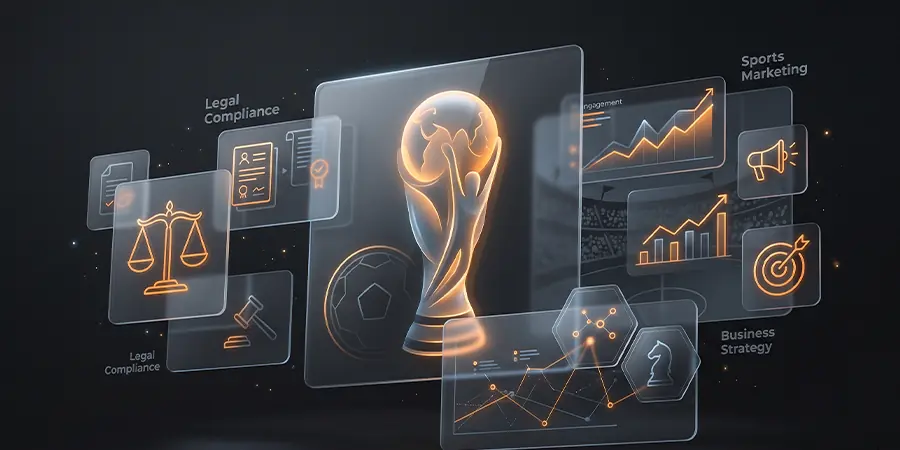
As Turkey prepares for the 2026 FIFA World Cup, businesses may want to share the football excitement with their customers. Many brands are already planning to make special match broadcasts in their branches, design tournament-specific packaging, or set up thematic loyalty programs. However, when these campaigns, excitedly prepared by marketing teams, do not pass through a legal filter, they can expose businesses to very serious sanctions.
FIFA’s Intellectual Property Axis and Red Lines
FIFA has globally registered almost every detail regarding the World Cup and protects these rights extremely aggressively. FIFA’s red lines, constantly scanning digital platforms and trademark registries, are clear. Some of the registered assets that only official sponsors can use for commercial purposes are:
- Official Emblem, Slogan, Mascot, and Trophy Image
- Specially designed “FWC 26” typeface
- Critical word marks such as “FIFA World Cup 26”, “World Cup”, “FIFA”, “Copa Mundial”.
It should not be forgotten that in past tournaments, FIFA detected and legally stopped even a local business from selling promotional products bearing just the phrase “World Cup”.
Thanks to international agreements to which Turkey is a party (especially the Paris Convention) and protections before WIPO, FIFA’s registrations are under full guarantee in our country as well. The Industrial Property Code (IPC) No. 6769 strictly prohibits the commercial use of registered signs without the explicit permission of the trademark owner.
Even if the sector your business operates in has nothing to do with sports; using these registered phrases without permission in your campaigns, menus, or social media visuals can be a major risk.
The sanctions for this violation are not limited to just stopping the broadcast, advertisement, or campaign. In case of infringement, businesses;
- May face material compensation lawsuits demanding the return of the profit FIFA was deprived of or the unfair profit the business obtained,
- Claims arising from the damage to the brand image,
- May face very severe commercial and financial sanctions such as the confiscation and destruction of the promotional products, custom-designed packaging, posters, and even printed menus subject to the infringement.
In short, an unauthorized step you take while trying to integrate the enthusiasm of the tournament into your own brand can turn into a legal bill that is difficult for your business to overcome.
So, how will businesses overcome these strict boundaries in their social media campaigns and special promotions? Is the price of celebrating the tournament unfair competition lawsuits? We will examine the answer to these questions and the danger of “Ambush Marketing” in detail in the second part of our article series.
ARTICLE 2: Social Media Campaigns and Ambush Marketing
BRINGING THE WORLD CUP ENTHUSIASM TO CAMPAIGNS: AMBUSH MARKETING AND UNFAIR COMPETITION
In the first part of our article series, we discussed the national and international trademark infringement risks that brands may face during the 2026 FIFA World Cup process. In this section, we examine the legal loopholes created especially by marketing strategies in the digital field.
During major sports organizations, one of the strategies brands resort to most frequently, but navigate in the most legally dangerous waters, is the “ambush marketing” method. This strategy is; the brand establishing a commercial connection in a way that creates the impression as if it were an official sponsor of the tournament, without paying any license fee.
Where is the Fine Line of Celebrating the Tournament?
Even FIFA acknowledges in its guidelines that businesses have legitimate ways to reflect the general football enthusiasm. However, the golden rule here is to avoid amateurishly designed wordplays. While a football fan sharing tournament visuals on their own social media remains within editorial limits, a commercial business doing so could be considered commercial unfair use.
In terms of Turkish law; marketing using the image of a tournament with which you have no official relationship means violating not only trademark law but also directly the unfair competition provisions of the Turkish Commercial Code (TCC).
The Hidden Danger in Partnerships and Sponsorships
Another critical issue to be noted is jointly conducted campaigns. If the third-party brand you collaborate with is not an official sponsor of FIFA, it cannot grant you any permission or right of use arising from FIFA rights. Because no one can transfer a commercial right they do not own to someone else. In this case, both brands will be held jointly liable for unauthorized commercial association. Every detail, from product packaging to menu naming, must be meticulously examined to see whether it creates an unfair commercial association with the tournament.
The risks in marketing activities are not limited only to the TCC and IPC. Did you know that the prediction games frequently organized by businesses can actually harbor crimes requiring severe penalties? In the 3rd part of our article series, we will discuss the hidden dangers on the axis of betting legislation.
ARTICLE 3: Prediction Games and the Danger of Illegal Betting
GAMIFICATION SETUPS IN BUSINESSES: SCORE PREDICTIONS AND ILLEGAL BETTING LEGISLATION
In previous parts of our World Cup article series, we examined intellectual property and unfair competition risks. In this section, which is the most critical link of our series, we focus on the criminal law dimension of the gamification setups that businesses use to increase customer loyalty.
Social media contests and loyalty games in mobile apps, which are the heart of marketing activations, are among the areas FIFA pays the most attention to.
Today, many brands organize campaigns through their mobile applications or physical stores that sound extremely innocent, such as “Guess the score of the match, grab the free coffee” or “Predict the result of the derby, win the discount”.
However, in the background, these setups harbor very serious sanction risks under the Law No. 7258 on the Arrangement of Betting and Games of Chance in Football and Other Sports Competitions.
The Misconception of “We Don’t Charge an Entry Fee, Why Should It Be Considered Betting?”
The most common misconception brands fall into is the thought that the setup will not be considered a bet because no participation fee or money is taken from the consumer. However, the situation is different in criminal law doctrine and established precedents: Even if no fee is charged to consumers, offering a predetermined and guaranteed material gain (free coffee, gift certificate, etc.) dependent on the condition of predicting the outcome of sports competitions carries the risk of being evaluated as a fixed-odds betting mechanism. According to the law, it is not required for the organizing brand to directly gain a financial benefit for the crime of organizing illegal betting to occur.
Severe Criminal Sanctions and the Risk of Workplace Closure
If such a setup is evaluated within the scope of illegal betting, the sanctions stipulated by the law are devastating for corporate companies:
- Imprisonment and Fine: According to Article 5 of Law No. 7258, those who have these games played or provide the opportunity are tried with imprisonment from 3 to 5 years and a judicial fine of up to ten thousand days.
- Crime of Encouragement: Those who encourage people by advertising receive an imprisonment sentence from 1 to 3 years.
- Workplace Closure: Workplaces where the crime is committed are sealed for 3 months without warning by the local civil authority, and their operating licenses are canceled within 5 days.
So how can brands transform these setups into a safe loyalty program while preserving their engagement goals? How should the technical and legal infrastructure of this transformation be provided?
We summarize the ways to secure all these processes in the final part of our series.
ARTICLE 4: Conclusion and Safe Legal Strategies
SECURE YOUR BUSINESS DURING THE WORLD CUP PERIOD: THE IMPORTANCE OF PROFESSIONAL LEGAL CONSULTING
We are at the last part of our World Cup article series, where we discussed many specific issues from intellectual property infringements to unfair competition, from ambush marketing risks to betting legislation requiring severe penalties.
Having the wind of major organizations at your back is a great marketing opportunity. There are legal and legitimate grounds, including FIFA guidelines, for businesses to integrate the tournament enthusiasm into their commercial activities. However, these boundaries are subject to extremely fine lines.
Before publishing your campaigns, you must pass your projects through a detailed legal filter. Contests containing the FIFA logo or registered phrases, directly focused on knowing the outcome, and in the nature of betting are in the High Risk group for your brand. On the other hand, loyalty setups that use generic football terminology and are completely stripped of the betting mechanism represent the safe zone. Determining which word, which visual, or which reward setup poses a risk requires a serious regulatory analysis. The solution is not to stay away from these organizations; but to expertly redesign your gamification dynamics without getting caught in the National Lottery Administration and Criminal Law legislation.
As Nexpo Legal, we fully understand these visionary commercial goals of your brand and work for you to build your creative projects on the safest legal ground. At every stage of the process, our main objective is to eliminate potential infringement and compensation risks, protecting your business from loss of reputation.
It is imperative that every design and campaign to go to the printing press or digital publication goes through a comprehensive intellectual property and advertising law review before publication. We would like to state that we stand by you as your strategic solution partner in the steps to be taken, and remind you that you can contact our office for the management of your corporate processes.
Ezgi Salt
Nexpo Legal