





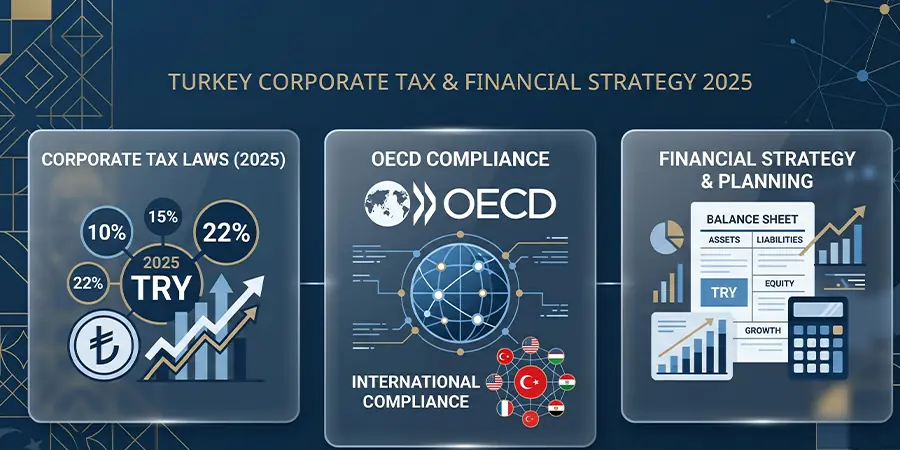
The corporate tax landscape in Turkey has undergone profound structural transformations during recent legislative cycles. Driven by a dual approach, the Turkish government seeks to align with the OECD’s base erosion frameworks on one hand, while aggressively striving to position the Republic of Turkey as a premier destination for Foreign Direct Investment (FDI) and macro-business (B2B) development on the other.
The year 2025 marks a turning point in the execution of these strategies. For multinational corporations, institutional investors, and businesses operating within Turkey, understanding these changes is no longer merely a legal compliance requirement; it constitutes the foundational pillar of supply chain optimization and cross-border strategic structuring. In this article, based on the latest legal updates, we provide an in-depth analysis of the new regulations and tax changes in Turkey for the year 2025.
1. Introduction of the Domestic Minimum Corporate Tax (10% Rate)
One of the most significant structural changes for the 2025 fiscal year is the implementation of the Domestic Minimum Corporate Tax law. Effective for financial periods beginning on or after January 1, 2025, this tax legislation mandates that a company’s final tax liability cannot mathematically fall below 10% of its commercial balance sheet profit (prior to the application of certain specific deductions and exemptions).
Under this mechanism, taxpayers are legally obligated to calculate their tax across two parallel systems and remit the higher amount to the tax administration:
- The Standard System: Calculating tax at the standard rates (e.g., 25% for regular companies, 30% for financial institutions, 20% for exporters) after fully deducting all exemptions.
- The Minimum Tax System: Applying a strict 10% rate to the gross commercial profit (by adding statutorily non-deductible tax expenses back into the calculation base).
Protected Exemptions: To support the innovation economy, exemptions related to technology development zones, Research and Development (R&D) activities, and dividends received from Turkish resident companies are excluded from this 10% floor. Furthermore, newly established companies are fully exempt from this law for a grace period of 3 years.
2. Full Integration of the Global Minimum Tax (OECD Pillar Two)
Parallel to domestic laws, Turkey is aggressively implementing the Global Anti-Base Erosion (GloBE) standards to combat tax evasion. These rules target Multinational Enterprises (MNEs) with consolidated global revenues exceeding 750 million Euros, ensuring they pay a minimum effective tax rate of 15% globally.
Key changes in 2025 within this section include:
- Undertaxed Payments/Profits Rule (UTPR): Effective January 1, 2025, this rule acts as a legislative backstop. If a parent company is located in a jurisdiction that has not implemented the Income Inclusion Rule (IIR), the subsidiary in Turkey is obliged to pay a mathematical portion of the global top-up tax to ensure the 15% minimum is met.
- Compressed Reporting Deadlines: The deadline for submitting the Qualifying Domestic Minimum Top-Up Tax (QDMTT) return for in-scope companies in Turkey is strictly set for December 31, 2025, placing massive pressure on the financial departments of multinational corporations.
3. Suspension of Hyperinflation Accounting (2025-2027)
Due to severe inflationary pressures, Turkey formally entered hyperinflationary economy status (according to the IAS 29 standard) starting in 2022. Inflation accounting prevents the unjust taxation of “phantom and unrealized profits” caused by currency devaluation.
However, in a stabilizing legislative maneuver (Law No. 7571), the Turkish government has explicitly suspended the application of statutory inflation adjustments for corporate tax purposes for the entirety of the 2025, 2026, and 2027 accounting periods.
- Crucial Exception: Only taxpayers exclusively engaged in the purchase, sale, or manufacturing of processed gold and silver are exempt from this suspension and must continue to submit inflation-adjusted balance sheets.
- Strategic Note: Foreign subsidiaries in Turkey must recognize that while they do not need to apply hyperinflation accounting for local statutory tax purposes, their foreign parent companies must still apply inflation accounting in their global consolidated financial reporting in accordance with international standards (IFRS).
4. New Restrictions on Investment Incentive Certificates
The recently enacted omnibus Law No. 7555 imposes strict limitations to prevent an open-ended drain on government tax revenues. For certificates issued from mid-2025 onwards:
- 10-Year Time Limit: The duration for utilizing the reduced corporate tax incentive is now strictly capped at a maximum of 10 years (or 10 financial periods). If the tax credit is not fully utilized within this window, the remaining credits expire worthless.
- Rate Standardization: The corporate tax reduction rate, which previously fluctuated based on the investment region, is now rigidly standardized at a flat rate of 60% nationwide.
5. Increase in Withholding Tax Rate on Dividends
In a significant move to retain domestic capital and boost immediate treasury revenues, the Withholding Tax (WHT) rate on dividends paid by Turkish resident companies to non-resident foreign individuals or entities has increased by 50%, jumping from 10% to 15%.
Crucially, dividends paid between two Turkish resident companies remain tax-neutral (0%) to fully preserve the structure of domestic holding companies. To mitigate this 15% rate, foreign investors must heavily rely on Double Taxation Avoidance Agreement (DTAA) networks to extract their profits from Turkey as tax-efficiently as possible.
Frequently Asked Questions
1. Are newly established companies subject to the 10% domestic minimum corporate tax in 2025?
No. To support entrepreneurship and attract fresh capital inflows, newly established legal entities and companies are completely exempt from the 10% domestic minimum tax rule for their first three active financial periods.
2. Which businesses are exempt from the suspension of hyperinflation accounting from 2025 to 2027?
Under Law No. 7571, all companies are prohibited from attaching inflation-adjusted balance sheets to their tax returns, except for companies whose business model is exclusively tied to the trading, purchase, sale, or manufacturing of processed gold and silver. These specific entities must continue to apply inflation accounting
3. What is the deadline for submitting the QDMTT (Local Top-Up Tax) return?
Turkey is an "early filing" country, having implemented this mechanism ahead of many European nations. The specific submission deadline for the Qualifying Domestic Minimum Top-Up Tax (QDMTT) return for in-scope companies is aggressively set for December 31, 2025.
4. What is the withholding tax rate on dividends for foreign companies in 2025?
The baseline domestic Withholding Tax rate on dividends distributed to non-resident individuals and companies has increased from 10% to 15%. However, if a Double Taxation Avoidance Agreement (DTAA) exists between Turkey and the recipient's jurisdiction (such as Germany or the UAE), this rate may be significantly reduced, often to between 5% and 10%.
5. Are Investment Incentive Certificates obtained prior to 2025 subject to the new 10-year time limit?
No, the stringent new restrictions (including the 10-year cap and the 60% standardized reduction rate) exclusively apply to certificates for which applications were submitted on or after June 16, 2025. Legacy certificates generally retain their original rights and conditions.