





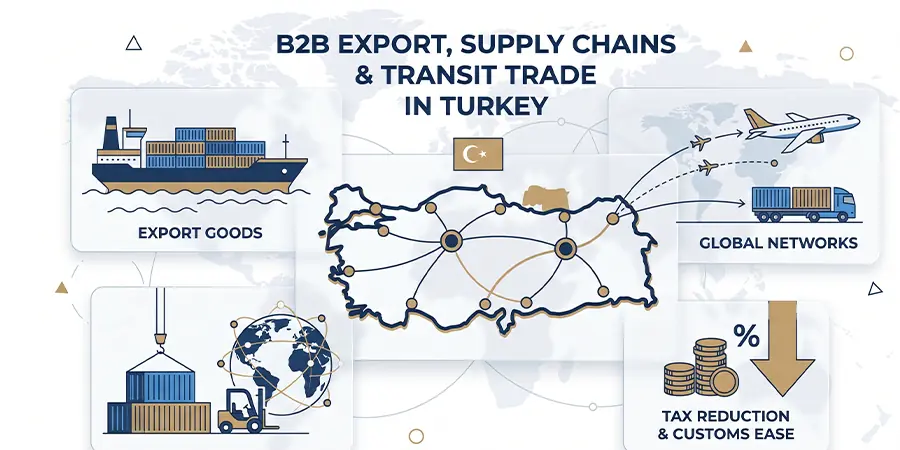
The corporate tax landscape in Turkey has undergone profound structural transformations during recent legislative cycles. The primary objective of these changes is to align with global standards and position Turkey as a highly attractive hub for Foreign Direct Investment (FDI). For business system architects and companies operating on a wholesale and B2B scale, understanding these complex mechanisms is no longer just a legal compliance requirement; it is the backbone of supply chain optimization and strategic corporate tax structuring in Turkey.
Based on the documentation and enacted laws for the 2025 and 2026 fiscal years, this article provides a detailed examination of the rates, exemptions, and critical business incentives for exporters.
Base Architecture of Corporate Income Tax (CIT)
The standard Corporate Income Tax (CIT) rate for the 2025 and 2026 fiscal years for resident and non-resident companies (outside specific financial and infrastructure sectors) is set at 25%. However, the financial sector (such as banks and insurance institutions) faces a punitive rate of 30%.
The macro strategy of the Turkish government in this area is to directly support local production; therefore, the net profit of resident companies derived exclusively from documented manufacturing activities benefits from a 1-point reduction, bringing the effective rate to 24%.
Strategic Incentives for Exporters and Industrial Suppliers
The greatest competitive advantage in the new tax structure is allocated to export-oriented operations. Exporters implicitly benefit from a 5-point tax reduction, lowering their corporate tax rate to 20%. This reduced rate is applied strictly and exclusively to the net income generated from export operations.
In the architecture of B2B supply chains and the wholesale trade of industrial materials—such as paraffin and chemical products—leveraging this reduced rate requires the implementation of a highly precise cost-accounting system. This system must be capable of cleanly segregating export revenues from domestic income to ensure the 20% rate is validated without challenges during state tax audits.
Prospect of Drastic Rate Reductions in the 2026 Program
Under the proposed “Strong Investment Hub Program,” which is currently navigating parliamentary approval, tax rates for exporters are set to be drastically reduced to capture a larger share of global markets:
- Manufacturing Exporters: Tax rate reduced to 9%.
- Export Trading Companies (without manufacturing lines): Tax rate reduced to 14%.
These upcoming changes signal a clear policy vector aimed at transforming Turkey into an unparalleled hub for managing industrial procurement and re-exports.
Transit Trade Exemptions
One of the most lucrative sectors for holding companies and international trading firms is transit trade (purchasing goods from abroad and selling them to a third country without the goods physically entering Turkish customs territory). Under the new laws:
- Companies located in the Istanbul Finance Center (IFC): Enjoy a 100% corporate tax exemption on transit trade profits.
- Companies outside the IFC: Enjoy a 95% exemption on similar revenues.
These exemptions, coupled with the updated “Wealth Amnesty” (Varlık Barışı) regulations, heavily facilitate the friction-free inflow of capital and its deployment into tax-shielded transit operations.
The 10% Domestic Minimum Tax Regime
Starting in early 2025, the Turkish legislature established a protective floor for state revenues, mandating that a company’s final tax liability cannot mathematically fall below 10% of its commercial balance sheet gross profit. This law structurally limits strategies that previously utilized multiple exemptions to drive effective tax rates down to zero.
However, to encourage entrepreneurship and the influx of new capital, newly established corporate entities are completely exempt from this 10% domestic minimum tax rule for their first three active fiscal periods.
New Restrictions on Investment Incentive Certificates (IIC)
For large-scale industrial and infrastructure projects, the government issues Investment Incentive Certificates. Under the newly enacted Law No. 7555 (effective mid-2025), aggressive new limits have been imposed:
- Time Limit: The duration for benefiting from the reduced corporate tax incentive is now strictly capped at a maximum of 10 years (or 10 fiscal periods).
- Rate Standardization: The corporate tax reduction rate has been uniformly standardized across all regions nationwide to a flat 60%.
Frequently Asked Questions (FAQ)
1. Can accumulated tax losses be carried forward to future years?
Yes, Turkish tax law allows companies to carry forward their net operating losses for a maximum continuous period of 5 consecutive fiscal years to offset future taxable income. There is absolutely no provision for the carry-back of losses to recoup previously paid taxes in this system.
2. How are B2B cross-border service exports taxed?
Based on Presidential Decision No. 11257 (effective April 2026), Turkish companies providing specialized professional services (such as software development, engineering, architectural design, and internet-based services) to non-residents, where the services are utilized exclusively abroad, benefit from a 100% tax deduction on these revenues. This effectively reduces the corporate tax burden on qualifying income to 0%, provided the foreign currency receipts are remitted into Turkish bank accounts within the legally stipulated deadlines.
3. How long is the suspension of hyperinflation accounting valid?
According to Law No. 7571, the application of statutory inflation adjustments for corporate tax purposes has been explicitly suspended for the entirety of the 2025, 2026, and 2027 accounting periods. The only statutory exception to this rule applies to corporate taxpayers exclusively engaged in the trading, purchase, sale, or manufacturing of processed gold and silver.